Persistent Low Back Pain

Nothing has worked.Amos was built for you.

95%of Align’s back pain clients reduce or eliminate their pain.

You’ve seen the surgeon. Tried PT, injections, pills, the chiropractor. None of it was built for what you have. Amos was — a structured recovery program built from a decade of in-person clinical work with thousands of patients. Not a 30-day reset. A path.

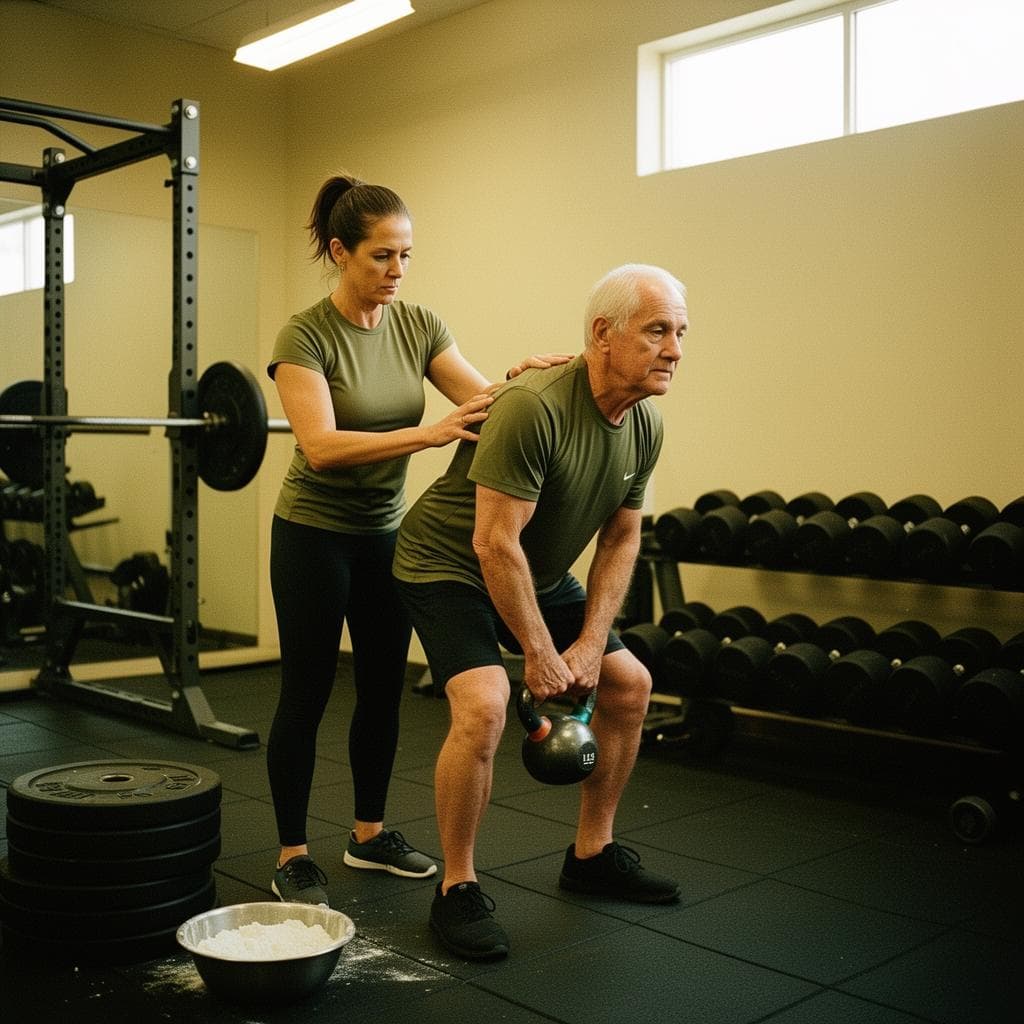
Female coach in her early 40s guiding an older client through a controlled hip hinge with a kettlebell at the Align gym in Redding, California
95%
pain reduction or elimination among Align members
10+ yrs
in-person clinical practice
1,000s
of patients treated
60-day
pain-reduction guarantee

If you’re here, you’ve already done this.

  • Imaging that explained nothing.
  • A surgeon who said “we can try.”
  • PT that helped for a week.
  • Injections that wore off.
  • Pills you didn’t want to take.
  • A chiropractor on retainer.
  • And here you still are.

This isn’t a willpower problem. The system that’s been treating you wasn’t built for what you have.

Philosophy

Process over diagnosis.

Conventional chronic pain care is organized around diagnosis. Find what’s wrong. Name it. Treat it. The problem: nobody can reliably diagnose non-specific chronic low back pain. Imaging doesn’t predict pain. Pain doesn’t predict imaging.

After three months, the pain is rarely one thing. It’s the downstream signature of multiple systems failing together. The diagnostic model — built for acute injury — doesn’t transfer to this population.

So we don’t lead with diagnosis. We lead with process. A disciplined sequence: address the most likely contributors, measure response, iterate. The work isn’t to guess the answer. The work is to run the algorithm.

The Path

From pain to longevity.

Recovery is not a single event. It is a path with phases. Each phase requires different work. Skipping phases is the most common reason people fail.

01

Pain Mitigation

Get the system out of high-pain, high-fear state. Reduce flares. Restore basic confidence in movement. Most members reach this within 30 days.

02

Stability

Build the foundation. Joint range of motion, neuromuscular balance, proprioception, nervous-system regulation.

03

Strength

Load the system. Build the capacity that protects the spine under real-world demand. Strength is what keeps pain from coming back.

04

Performance

Return to the activities that matter. Work, sport, parenting, life. Function becomes the new baseline.

Then

Longevity.

Stay strong. Stay out of pain. Build capacity that protects you for decades. Recovery ends; the practice continues.

Most members see meaningful change inside the first 90 days. Full progression typically takes 6–12 months. Longevity is the work of years.

Outcomes

Real people. Real bodies. Real outcomes.

Members of our in-person clinic in Redding, California. Same protocols delivered through Amos.

Christian, 52

Finance manager, Sacramento

Pain before
8 / 10
4 years of pain
Pain now
2 / 10
Week 14 on Amos

Before: Couldn’t sit through a one-hour meeting. Slept on the floor.

Now: Full work days. Hiking weekends with his kids again.

I stopped trying to figure out what was wrong with me and started doing the work. That was the shift.

Linda, 58

Elementary teacher, Redding

Pain before
7 / 10
6 years of pain
Pain now
1 / 10
Week 22 on Amos

Before: Couldn’t stand a full class. Two epidurals, no lasting relief.

Now: Teaches all day standing. Walks two miles after school.

Three doctors told me to live with it. Amos didn’t. The plan changed every week and so did I.

Ray, 61

Retired contractor, Anderson

Pain before
9 / 10
11 years of pain
Pain now
3 / 10
Week 30 on Amos

Before: Couldn’t pick up his grandson. One discectomy, still flaring.

Now: Back in his shop. Deadlifts 135 for reps without flaring.

I’d given up. What worked was someone telling me exactly what to do, then adjusting it when my body talked back.
7.2 / 10
Average pain score on intake
Across Align members presenting with chronic low back pain
2.4 / 10
Average pain score at week 12
Same cohort, same self-reported 0–10 scale
78%
Meaningful function restoration in 90 days
Return to a key activity they couldn't do at intake

Composite member stories shown for illustration. Pain scores and outcomes reflect Align’s in-person clinical data, 2014–2024. Photos and quotes will be replaced with named members prior to launch.

The Practice

What a week with Amos actually looks like.

  1. 115 min

    Intake assessment

    Structured baseline. Pain, mobility, function, history. Identifies your three most likely contributors.

  2. 220–30 min

    Your daily practice

    Targeted mobility, stability, and strength work calibrated to your phase. 3–4 days a week. No more.

  3. 32 min

    Daily check-in

    Pain, energy, what felt off. Amos adapts the next session based on what your body is telling us.

  4. 4Coach call

    Weekly review with a human coach

    A coach from Align reviews your data, adjusts the plan, answers questions. You are not alone with an app.

Who Amos is built for.

This is for you if

  • +You’ve had chronic low back pain for 6+ months.
  • +You’ve tried multiple conventional approaches without lasting relief.
  • +You can commit to 3–4 sessions per week of 20–30 minutes.
  • +You want to do the work, not skip it.

This is not for you if

  • You’re looking for a 30-day reset or a quick fix.
  • You have an undiagnosed acute injury (see a doctor first).
  • You’re not willing to make sustained changes to how you move and live.
  • You expect us to fix you while you’re passive.
The Guarantee

If your pain isn’t reduced in 60 days, you don’t pay.

We’re confident in this work because we’ve watched it succeed for thousands of people. Sign up, commit to 3–4 days a week of practice, and if you don’t see meaningful pain reduction in 60 days, we refund your investment in full. Conditional only on you doing the work.

Why the condition? Because the program only works if you run it. The guarantee protects people who do.

By Align

Authority comes from the work.

Align is the in-person clinical practice in Redding, California where this model was built. A decade of work. Thousands of clients. Real rooms, real bodies. David Woodward developed the protocol; his daughter coaches members in the gym every week. Amos is the scaled, AI-delivered expression of that work.

We are not asking to be trusted because of our letters. We are asking to be trusted because of the work.

Effectiveness

The measure is whether people get better. Not whether the program looks sophisticated. Not whether the marketing is elegant.

Loving kindness

Our members have been dismissed, rushed, disbelieved. We meet them with patience and care. The no-bullshit voice is not cold; it is honest.

Hope

Grounded hope. Built on what we have seen happen for real people doing the real work. Not the empty optimism of marketing.

Honest answers.

How is Amos different from physical therapy?

PT is built around discrete episodes of care — typically 6 to 12 visits aimed at a specific dysfunction. It works for acute injury. Chronic low back pain isn’t acute injury, and that’s why traditional PT often helps for a week and then fades.

Amos runs a longer arc and a different sequence. Pain mitigation, stability, strength, performance — phased work over months, not visits over weeks. Daily practice rather than three sessions a week with someone watching. A coach reviewing data each week to adjust.

What if my MRI shows a herniated disc, stenosis, or arthritis?

Imaging findings are real, but in chronic low back pain they don’t reliably predict pain. Plenty of pain-free people have ugly MRIs; plenty of people in agony have clean ones. Amos works with what your body does, not with what the picture says it should do. We don’t replace medical care for findings that need it — but we don’t organize the program around the diagnosis either.

How long until I feel better?

Most members see meaningful change inside the first 90 days. Full progression through the phases typically takes 6 to 12 months. Longevity is the work of years. We won’t promise you a timeline; we will tell you the truth — what we have seen happen for the people who do the work.

What does the program cost?

Pricing is published at sign-up. The 60-day pain-reduction guarantee applies — if your pain isn’t meaningfully reduced in 60 days and you’ve done the work, you don’t pay.

What equipment do I need?

Almost nothing for the early phases. A floor, a wall, and your body. Later phases bring in resistance — a band or two, eventually free weights — but the program meets you where you are. We don’t require a gym membership.

How much time per day will this take?

Twenty to thirty minutes, three or four days a week. Plus a two-minute daily check-in. Less time than most people spend scrolling before bed. More than enough to change a body if the sequence is right.

Can I do this if I’ve had back surgery?

Often yes — many of our members are post-discectomy or post-fusion. The program adapts. We’ll ask about your surgical history during the fit conversation. If your surgery is very recent or you have post-op restrictions, we’ll route you to your surgeon first.

What if I miss days?

You’ll miss days. Everyone does. The program is designed around adherence in the 70–80% range, not perfection. What matters is that you come back. The weekly coach review is partly about helping you do that.

How does the AI actually work?

The AI runs the algorithm. It takes your daily check-ins, your progress through the protocol, and your weekly coach’s notes, and it adjusts your plan accordingly. The protocol itself is the codified version of a decade of in-person clinical work — not generated, not guessed. The AI is how we deliver that work at scale, with the responsiveness of a coach who sees you every day.

What happens after 12 months?

Recovery ends; the practice continues. The work shifts from rebuilding capacity to maintaining it. Less time per week, the same posture toward the body. Most members stay on for the longevity practice because the alternative — letting it slide and watching pain creep back — is the thing they came here to avoid.

If everything else has failed, this is the next step.

A short fit assessment. Honest answers in, honest answer out.

Take the 90-Second Fit Assessment

If you’re not a fit, we’ll tell you directly.